
Raman Spectroscopy for Detection of Critical Minerals and Rare Earth Elements (REEs) - Lithium
Raman Spectroscopy for Detection of Critical Minerals and Rare Earth Elements Lithium
Critical minerals such as lithium, copper, cobalt, nickel, graphite, titanium, mica, beryl and rare earth elements (REEs) play a central role in emerging technologies including electric vehicles, renewable energy storage systems, and advanced electronics. With increasing global demand, there is a strong requirement for rapid, precise, and non-destructive techniques for mineral identification.
Conventional analytical methods—such as X-ray diffraction (XRD) and inductively coupled plasma mass spectrometry (ICP-MS)provide high accuracy but are often time-consuming, destructive, and unsuitable for on-site analysis during exploration. In contrast, Raman spectroscopy offers a fast, non-destructive approach capable of identifying minerals through their distinct molecular vibrational signatures.
In this study, lithium-bearing minerals, including Amblygonite, Lepidolite, and Petalite are evaluated using the IndiRAM™ CTR Raman spectrometer, demonstrating its capability for accurate mineral discrimination and supporting the development of a Portable Raman platform for field-based applications.
Materials & Methods
Raman spectra were acquired using the TechnoS Instrument`s make IndiRAM™ CTR Raman spectrometer, engineered to provide high spectral resolution, excellent signal-to-noise performance, and optical stability - characteristics essential for geological and mineralogical analysis. Three primary lithium-bearing mineral species were examined:
Each mineral possesses distinct structural motifs that result in characteristic Raman vibrational features. | 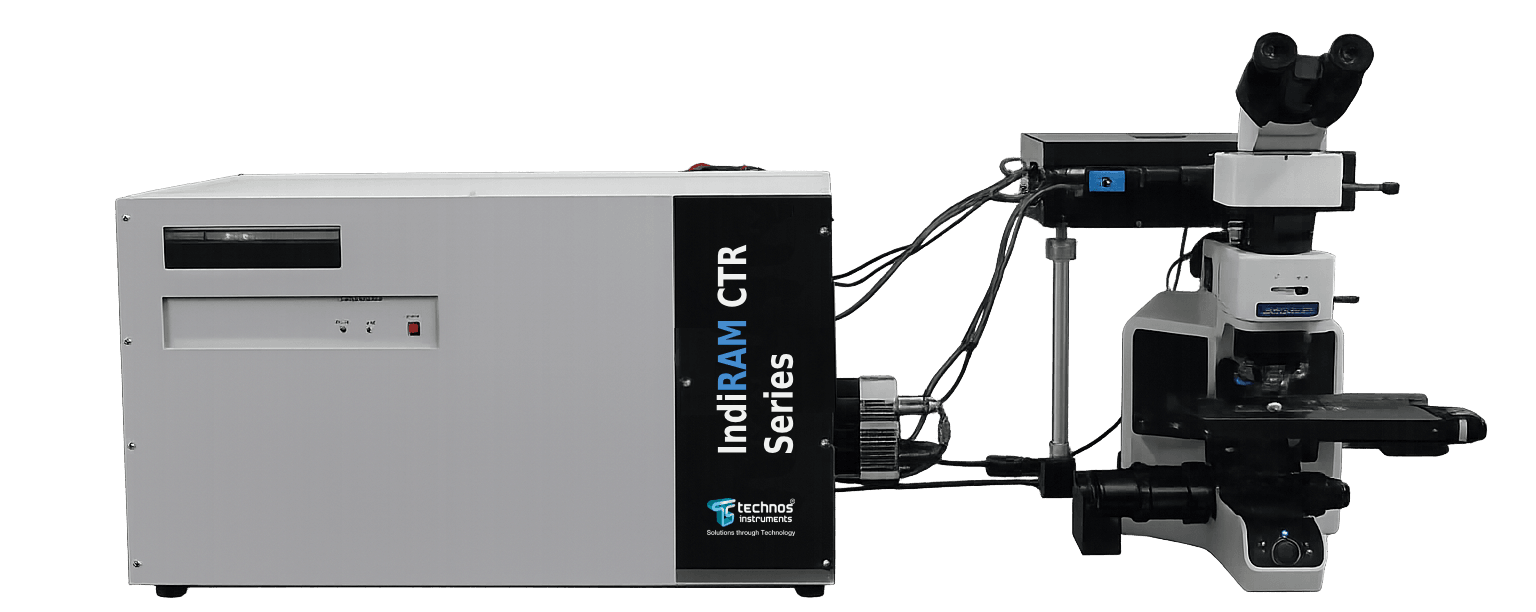 |
Results & Discussion
Amblygonite - Exhibits strong phosphate vibrational bands near ~700 cm⁻¹ and ~1100 cm⁻¹, consistent with PO₄³⁻ symmetric and antisymmetric stretching modes, 486 cm⁻¹ is attributed to symmetric Al–O–Al stretching, Low-Frequency Region (140–330 cm⁻¹) Features here relate to O–Li–O (or F) bending and Li–O bond vibrations.
Shows distinct layered silicate lattice vibrations, notably within the 250–350 cm⁻¹ region, along with an additional feature near ~750 cm⁻¹, characteristic of lithium-rich mica structures.
Displays diagnostic Li–Al silicate vibrational bands between 350–500 cm⁻¹, corresponding to bending and stretching modes of the aluminosilicate framework. These spectral differences provide clear mineralogical discrimination, enabling rapid identification of lithium ore types. | 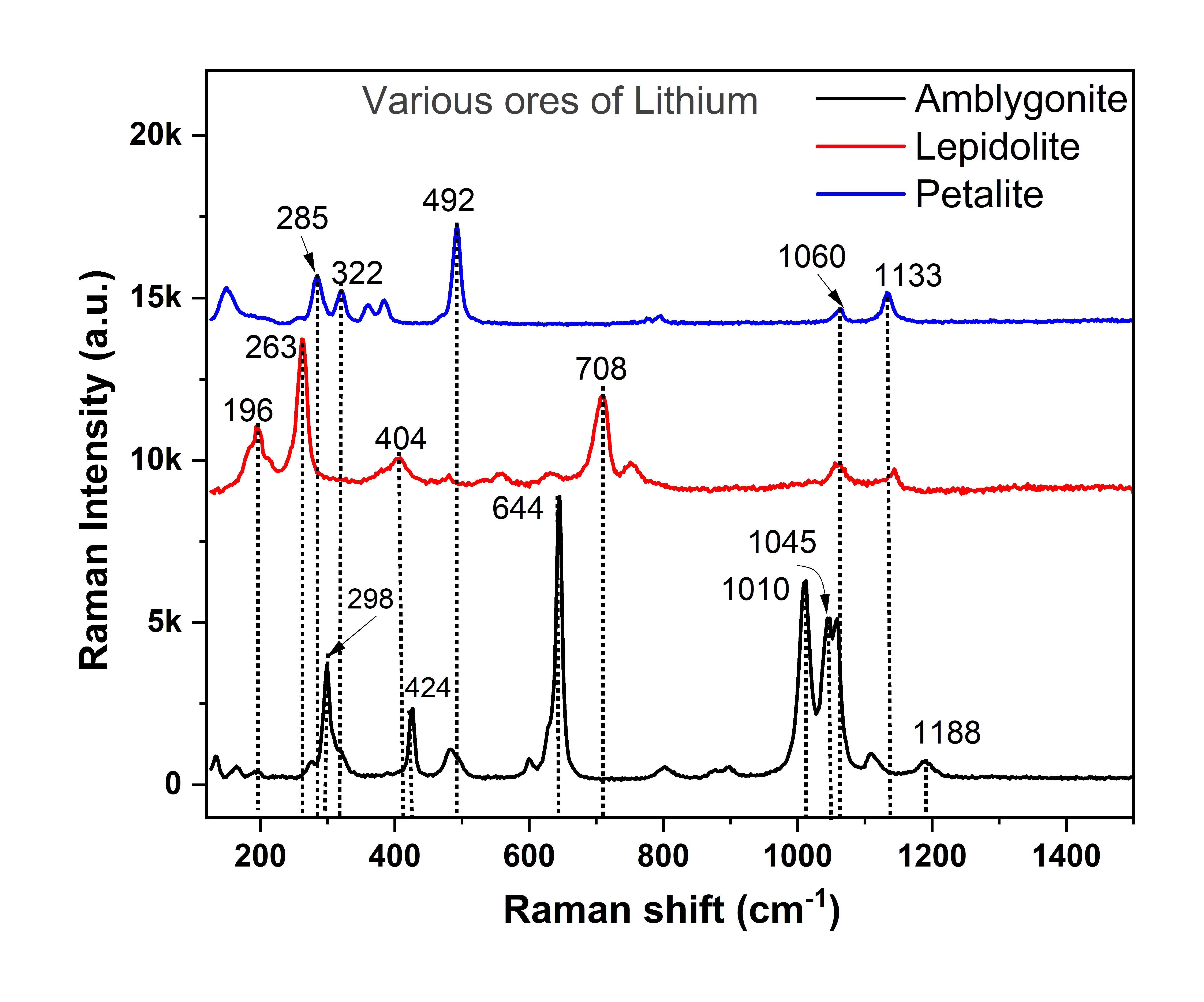 |
Conclusion
The distinct Raman signatures of Amblygonite, Lepidolite, and Petalite enable precise and rapid identification of lithium-bearing minerals, reinforcing Raman spectroscopy as an effective, non-destructive tool for geological exploration and mineral processing workflows.
Leveraging this capability, TechnoS Instruments is advancing the development of a Portable Raman Spectrometer designed for real-time, on-site mineral identification. This field-ready system will support rapid geological mapping, lithium screening, and REE detection without dependence on laboratory facilities, thereby improving efficiency and decision-making in mineral exploration.
References
1. Rinaudo, C., Gastaldi, D., & Croce, G. Raman characterization of lithium aluminosilicates. Journal of Raman Spectroscopy, 36, 810–816 (2005).
2. Dias, A., & Prudêncio, M.I. Raman analysis of lithium minerals. Spectrochimica Acta Part A, 199, 236–244 (2018).
3. McMillan, P.F. Vibrational spectroscopy of silicates. Physics and Chemistry of Minerals, 16, 245–254 (1988).
4. Data taken at IIGJ-Jaipur using IndiRAM CTR-300C Raman Spectrometer system.