Revolutionizing Raman Spectroscopy with SERS: Ultra-Sensitive Detection for the Real World
Revolutionizing Raman Spectroscopy with SERS: Ultra-Sensitive Detection for the Real World
May 5, 2025
What is SERS and Why It Matters?
SERS works by enhancing the Raman signal when molecules interact with nanostructured metal surfaces—typically silver, gold, or copper. This dramatic signal amplification is due to the Localized Surface Plasmon Resonance (LSPR) effect, where electromagnetic fields near metallic nanostructures concentrate and enhance scattered light.
There are two main mechanisms behind SERS:
Electromagnetic Enhancement: Strong enhancement due to intense local fields at metal nanostructures.
- Chemical Enhancement: Charge-transfer interactions between molecule and metal surface that fine-tune vibrational mode intensities.
This dual-action amplification turns Raman spectroscopy into a high-sensitivity detection method - ideal for real-world applications requiring both speed and precision.
Liquid vs. Substrate-Based SERS Approaches
SERS can be implemented in two major formats, depending on the nature of the sample and sensitivity required:
1. Liquid-Based SERS
Uses colloidal nanoparticles in suspension. The analyte is mixed with these particles, producing rapid signal enhancement.
- Advantages: Quick and easy; good for screening
- Limitations: Particle aggregation can affect reproducibility
2. Substrate-Based SERS
Utilizes fixed metal nanostructures (films or chips). The analyte is deposited directly on the substrate.
Advantages: More stable, reproducible, and suitable for quantitative work
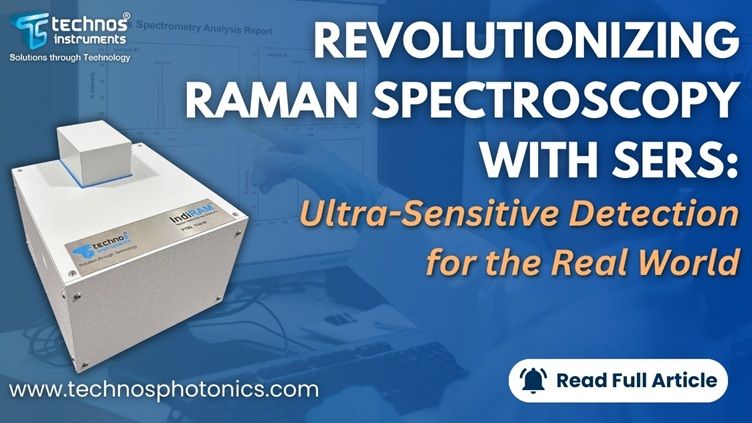
Limitations: Requires precision in substrate fabrication . TechnoS’ Raman spectrometers - the IndiRAM CTR, Portable and Handheld Series, support both approaches, making them versatile tools for research and field-based analytics.
Real-World Applications of SERS-Enhanced Raman - SERS has become a transformative tool in many scientific and industrial domains:
Biomedical & Diagnostics
- Detect cancer biomarkers, viruses, and bacteria
- Non-invasive analysis of bodily fluids, e.g. blood, for early disease detection
Pharmaceutical Quality Control
- Identify counterfeit drugs
- Analyse drug composition and molecular interactions
Food Safety & Adulteration Detection
- Rapid screening for pesticides, antibiotics, and artificial additives
- Detection of microbial contamination and spoilage markers
Environmental Monitoring
- Trace-level detection of pollutants in air, water, and soil
- Monitoring organic contaminants
Forensics & Homeland Security
- Trace detection of narcotics, explosives, and chemical agents
- In-field analysis of residues and inks
Advanced Materials & Nanoscience
- Study surface interactions at the nanoscale
- Track real-time chemical reactions in catalysts and materials
Whether you're testing water samples in the field or screening complex bio-fluids in the lab, having a robust, portable, and sensitive Raman spectrometer makes all the difference.
Bringing SERS to Life with IndiRAM Spectrometer
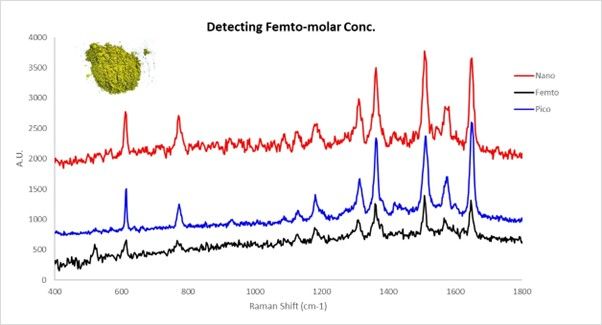
To truly harness the power of SERS, you need the right hardware—a system that’s sensitive enough to detect low-concentration signals, but also compact, rugged, and easy to use. This is exactly where the IndiRAM Systems from TechnoS Instruments excel. Designed with either of 532, 785, 1064 nm lasers, IndiRAM systems are optimized for SERS applications across a broad spectrum of sample types. Their compatibility with both liquid-phase nanoparticles and solid SERS substrates offer unmatched flexibility for diverse workflows. Whether in a pharma QC lab, a food safety inspection unit, or a mobile forensic kit, the IndiRAM Spectrometer is enabling researchers and professionals to go beyond traditional detection limits.
The Future of SERS: Smarter, Smaller, Stronger
As nanotechnology advances and AI-based spectral analysis evolves, SERS is entering an era of even greater potential:
- Microfluidic-SERS integration for lab-on-a-chip devices
- Printed flexible SERS substrates for wearable sensors
- Portable systems like IndiRAM making Raman accessible anywhere
Real-time diagnostics in agriculture, healthcare, and security
These trends point to a future where SERS is not just a lab-based method—but a core component of everyday sensing and decision-making.
Final Thoughts
Surface-Enhanced Raman Spectroscopy (SERS) is transforming how we detect and analyse the world around us—making it possible to uncover invisible threats, ensure quality, and understand complex materials with unprecedented clarity. Tools like the IndiRAM CTR Series, P532_Tracer, P785_Tracer, P1064_Tracer, H785_Tracer, H1064_Tracer by TechnoS Instruments are accelerating this shift; combining lab-grade precision with real-world portability. Whether you're a scientist, analyst, or innovator, the future of ultra-sensitive detection is here—and it’s powered by SERS.
Related Articles
- Gemstone Identification with Raman Spectroscopy
- Field Testing Simplified: Benefits of Portable Raman Spectrometers
- Raman Spectroscopy for Illicit Drug Detection
- Quartz Identification Using Raman Spectroscopy
- IndiRAM Raman Spectrometer for identification of Excipients in Pharmaceutical Drugs
- Innovations in Raman Spectroscopy: TechnoS at the Forefront
- Microplastic Contamination Detection in Food Grains: A Raman Spectroscopy Approach
- How Raman Spectroscopy is Advancing Battery Material Analysis
- Raman Spectrometer Principle and Core Components