How Raman Spectroscopy Detects Food Adulteration
How Raman Spectroscopy Detects Food Adulteration Before It Reaches Your Plate
September 5, 2026
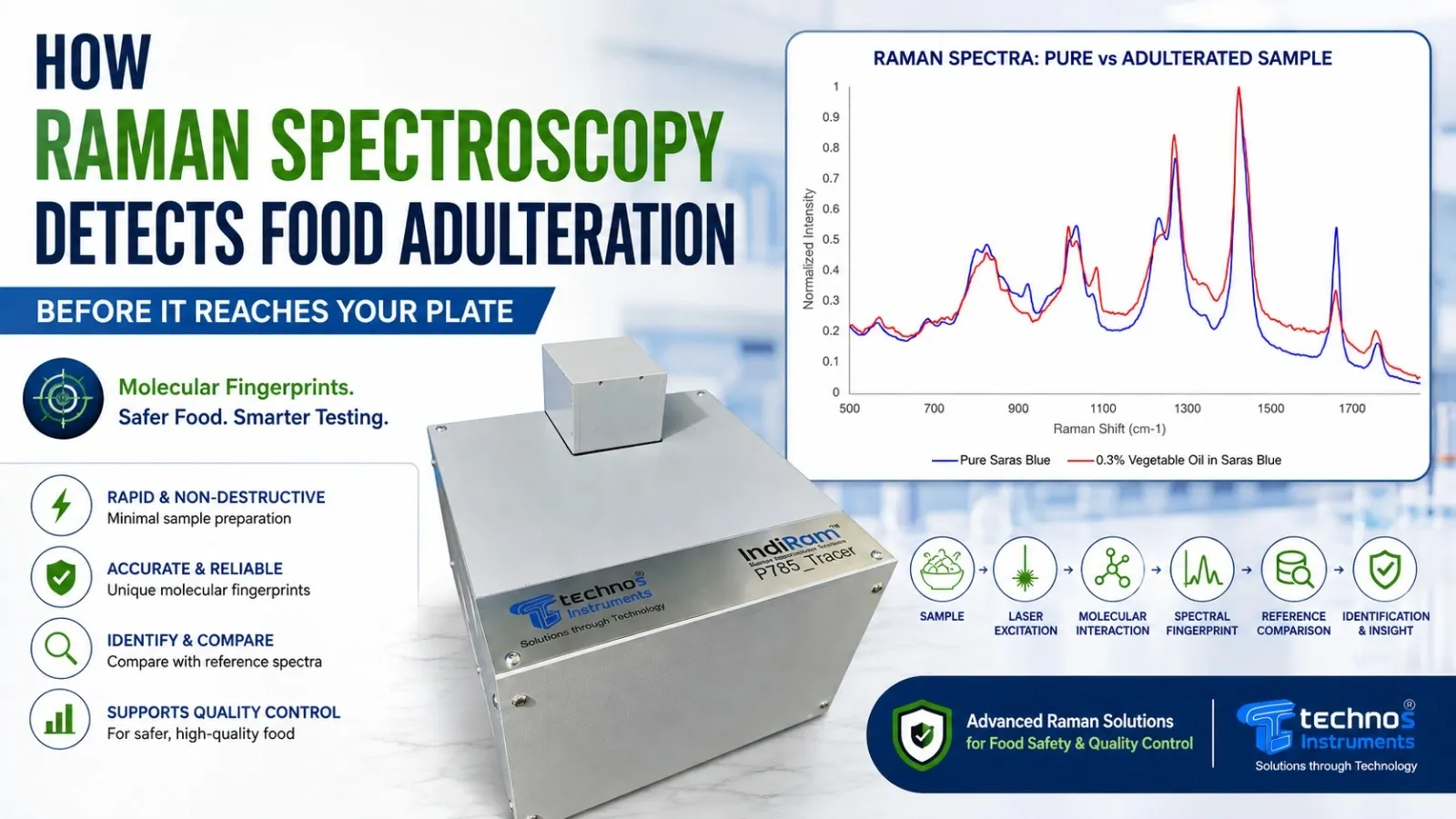
Food adulteration is often invisible. A product may look, smell and taste normal while containing unwanted substances, impurities or undeclared materials. This makes rapid and reliable analytical testing an important part of modern food quality and safety. One technology gaining attention for fast, non-destructive analysis is Raman spectroscopy.
What Is Raman Spectroscopy?
Raman spectroscopy identifies materials by studying how laser light interacts with molecular bonds.
When a laser illuminates a sample, most of the light is scattered without a change in energy. A small portion undergoes Raman scattering, producing a characteristic spectral fingerprint.
Think of it as a molecular barcode: different materials produce different Raman peaks, allowing scientists to distinguish and identify them. With an instrument such as the IndiRAM™ Portable Raman Spectrometer developed by TechnoS Instruments, Jaipur, these spectral fingerprints can be captured and analysed for material identification and quality-control applications.
This makes Raman spectroscopy a promising analytical approach for Raman Spectroscopy for Food Analysis, particularly where rapid screening and molecular characterization are required.
How Can Raman Help Detect Food Adulteration?
Traditional food testing can involve sample preparation, reagents, laboratory infrastructure and significant analysis time.
Food Adulteration using Raman Spectrometer technology offers a different analytical approach:
Sample → Laser Excitation → Raman Spectrum → Spectral Fingerprint → Identification & Comparison
The resulting spectrum can be compared with reference spectra to determine whether the material matches the expected composition or shows spectral differences that warrant further investigation.
Why this matters for food safety:
- Rapid analysis
- Minimal sample preparation for many applications
- Non-destructive testing
- Molecular-level identification
- Potential for screening multiple materials
- Useful for laboratory quality-control workflows
Raman is therefore not simply a "testing machine"; it is an analytical technique that provides chemical and molecular information from a sample.
Explore Our Raman Sampling for Food safety & Testing
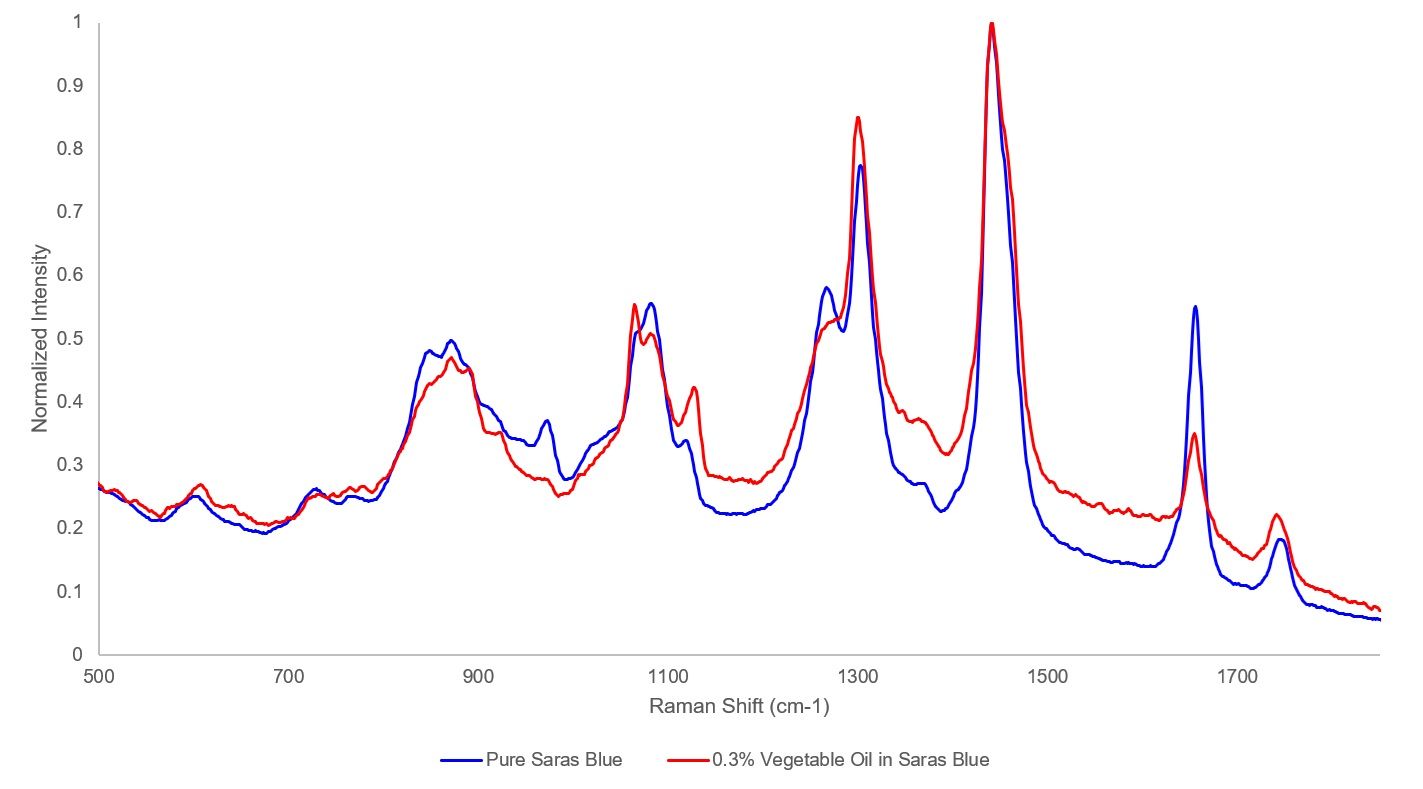
Raman Spectra from Packaging-Associated Food Samples
Our research data demonstrates the capability of the IndiRAM™ Raman Spectrometer to generate distinct Raman spectra from different sample materials. The experiments were performed using:
- 532 nm laser excitation
- 25 mW laser power
- 5-second exposure
- Five excitations per sample
The attached spectra show distinct Raman signatures, with characteristic peaks appearing at different Raman-shift positions.
From Laboratory Analysis to Food Safety
The real potential of Raman spectroscopy lies in moving from simply asking:
"What does this sample look like?"
to:
"What is this sample made of?"
This shift can support faster decision-making in food laboratories, quality-control facilities and research environments.
A Raman-based workflow can potentially help with:
- Screening - Quickly examine samples for unusual or unexpected spectral signatures.
- Identification - Compare observed Raman fingerprints against validated reference data.
- Quality Control - Support consistency checks between incoming raw materials and finished products.
- Research & Development - Study molecular characteristics and composition of food-related materials.
Where Does TechnoS Fit In?
TechnoS Instruments develops Raman spectroscopy solutions under the IndiRAM™ platform, supporting applications that require molecular identification and material characterization.
The IndiRAM™ Raman Spectrometer is designed for high-resolution Raman analysis and research applications where detailed spectral information is important. For food and related analytical research, Raman spectroscopy can open opportunities for:
- Food quality assessment
- Adulteration screening
- Raw-material identification
- Chemical characterization
- Research and laboratory analysis
- Development of spectral reference libraries
The objective is simple: turn molecular information into actionable analytical insights.
Food safety increasingly depends on analytical technologies that can provide speed, specificity and reliable molecular information.
Raman spectroscopy offers a powerful scientific foundation for this need. By capturing the molecular fingerprint of a material, it can complement conventional food-testing methods and support faster screening and characterization. The future of food quality control is not only about detecting adulteration after a problem occurs. It is about developing analytical workflows that can help identify potential issues earlier before products move further through the supply chain. From laboratory research to quality control, Raman Spectroscopy for Food Analysis has the potential to bring molecular-level analysis closer to real-world Food Testing applications.
Interested in exploring Raman spectroscopy for food quality, adulteration screening or laboratory research? Connect with TechnoS Instruments to learn more about IndiRAM™ Raman Spectrometers and Raman-based analytical solutions.
Related Articles
- Field Testing Simplified: Benefits of Portable Raman Spectrometers
- Gemstone Identification with Raman Spectroscopy
- How Raman Spectroscopy is Advancing Battery Material Analysis
- IndiRAM Raman Spectrometer for identification of Excipients in Pharmaceutical Drugs
- Innovations in Raman Spectroscopy: TechnoS at the Forefront
- Microplastic Contamination Detection in Food Grains: A Raman Spectroscopy Approach
- Quartz Identification Using Raman Spectroscopy
- Raman Spectrometer Principle and Core Components
- Raman Spectroscopy for Critical Minerals and Rare Earth Elements (REEs)
- The 5th C of Diamond Classification