Surface Enhanced Raman Spectroscopy
Surface Enhanced Raman Spectroscopy
Raman spectroscopy is a powerful technique for identifying molecules and understanding the chemical composition of materials. But there is one common challenge: Raman scattering is naturally very weak, especially when the target molecule is present at a very low concentration.
This is where Surface-Enhanced Raman Scattering (SERS) becomes important. By combining Raman spectroscopy with specially designed metallic nanostructures, SERS can dramatically increase the Raman signal and enable highly sensitive molecular analysis.
What Is Surface-Enhanced Raman Scattering (SERS)?Surface-Enhanced Raman Scattering (SERS) is a technique that enhances the Raman signal of molecules located on or very close to specially structured metal surfaces. SERS substrates commonly use metals such as silver (Ag) and gold (Au) because their free electrons interact strongly with incident light. These interactions can create extremely strong electromagnetic fields around the metal nanostructures. For scientific research and industrial laboratories, this means that molecules present at trace concentrations can produce measurable Raman signals that may be difficult to detect using conventional Raman spectroscopy. |
How Does Surface-Enhanced Raman Spectroscopy (SERS) Work?
The basic process is straightforward:
- A laser illuminates the sample.
The target molecules are located near an SERS-active metal surface.
- The incoming light interacts with the metal nanostructure.
This interaction produces a strong localised electromagnetic field.
- Molecules within this enhanced field generate a much stronger Raman signal.
The Raman spectrometer collects and analyses the enhanced spectrum.
The important part is the metallic nanostructure. Features such as nanoparticles, sharp edges, and tiny gaps between particles can concentrate electromagnetic energy into very small regions known as “hot spots". Molecules located in these regions can experience exceptionally strong Raman enhancement.
How Does LSPR Enhance the Raman Signal?
The key mechanism behind much of the electromagnetic enhancement in SERS is Localised Surface Plasmon Resonance (LSPR).
When light interacts with a metallic nanoparticle, the conduction electrons on its surface can oscillate collectively. When the frequency of the incoming light matches the natural oscillation of these electrons, LSPR occurs.
This resonance concentrates the electromagnetic field near the nanoparticle surface. If a molecule is located in this enhanced field, both the excitation of the molecule and the resulting Raman scattering can be strongly amplified.
The effect becomes particularly powerful around nanoparticle gaps and sharp structures, where electromagnetic fields can become highly concentrated.
Rhodamine Dye Analysis Using SERS (Surface Enhanced Raman Spectroscopy)
Rhodamine dyes are widely used in research, chemistry, and biological studies. At very low concentrations, their Raman signals can be weak. Surface-Enhanced Raman Spectroscopy (SERS) solves this by using gold or silver nanostructures to significantly enhance the Raman signal.
Rhodamine 6G (R6G) is a popular SERS test molecule, producing strong molecular fingerprints for sensitive detection even from very small samples. SERS-based Rhodamine detection enables rapid, highly sensitive analysis for forensic testing, environmental monitoring, pharmaceutical research, and laboratory applications.
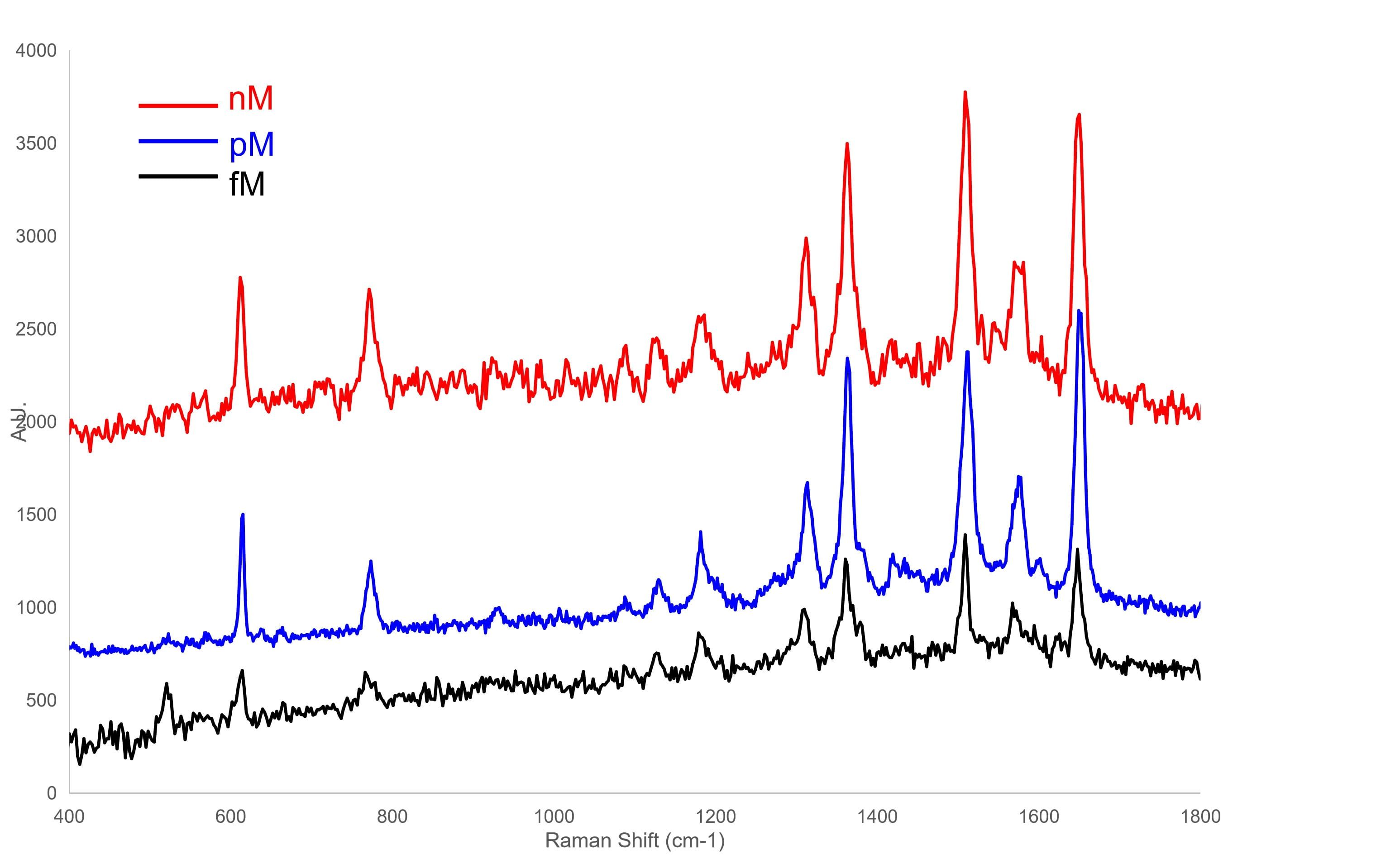
Fig : Femto-Molar Conc. of Rhodamine 6G using SERS
In the below figure, experimental SERS Raman results demonstrated that Rhodamine dye could be detected at concentrations ranging from the nanomolar (nM) to femtomolar (fM) level, highlighting the high sensitivity of the developed SERS platform.
Surface Enhanced Raman Spectroscopy (SERS) Application
Surface-Enhanced Raman Spectroscopy (SERS) provides a rapid and highly sensitive method for detecting pesticide residues through their unique molecular fingerprints.
| 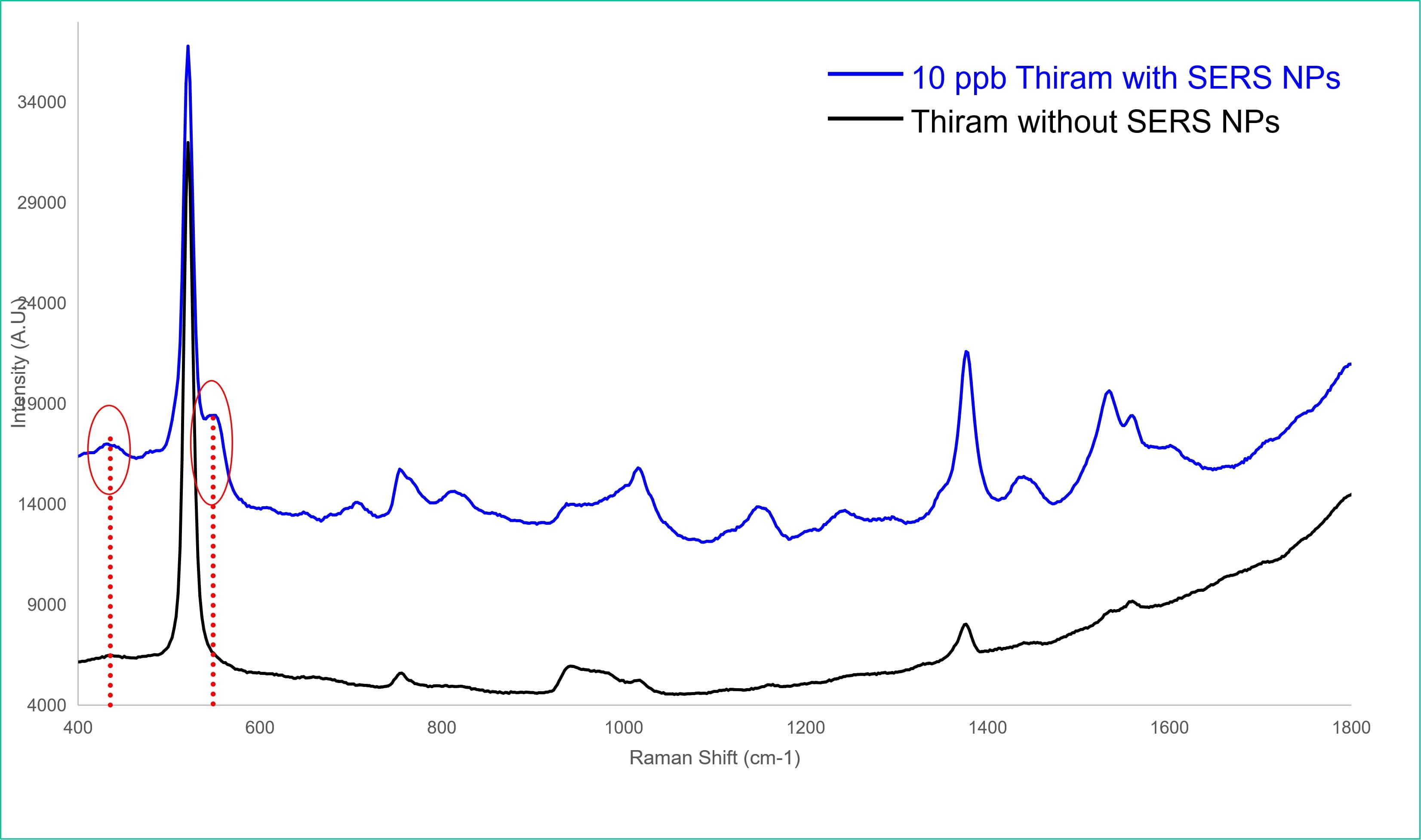 fig: Ultra-Low Concentration of Thiram Detection using SERS |
Request for Information
Do you have any questions or requests? Use this form to contact our team.