
How does Raman spectroscopy detects microplastics in water?
Raman spectroscopy detects microplastics in water
October 2, 2026

Microplastics now turn up almost everywhere researchers look: rivers, lakes, groundwater, drinking water and the open ocean. Most of these particles are too small to see with the naked eye, so knowing they are present is only half the job. Labs also need to know what the particles are made of. That is where confocal Raman spectroscopy for microplastics helps. The technique can analyse individual particles and read their molecular makeup, helping researchers identify the specific polymer they are made of.
What Are Microplastics?
Microplastics are plastic particles smaller than 5 mm. They come from larger plastic items that break down over time, from synthetic textiles, from packaging, from industrial processes and from other sources.
In water samples, the polymers you meet most often are polyethylene (PE), polypropylene (PP), polystyrene (PS), polyethylene terephthalate (PET) and polyvinyl chloride (PVC). Each has a different molecular structure, so each produces a different spectral fingerprint under a Raman instrument.
How Raman Spectroscopy Identifies Plastic Particles
A laser is aimed at the sample, and the scattered light is collected. Most of it returns at the same energy as the laser. A small fraction shifts in energy because it interacts with the vibrations of molecular bonds. Those shifts make up a Raman spectrum, which works like a fingerprint for the material. To identify a particle, you compare its spectrum with reference spectra of known polymers. If the peaks line up, you know the plastic type. This is the real strength of microplastic analysis using Raman spectroscopy: it does not stop at spotting particles. It tells you what each one is. | 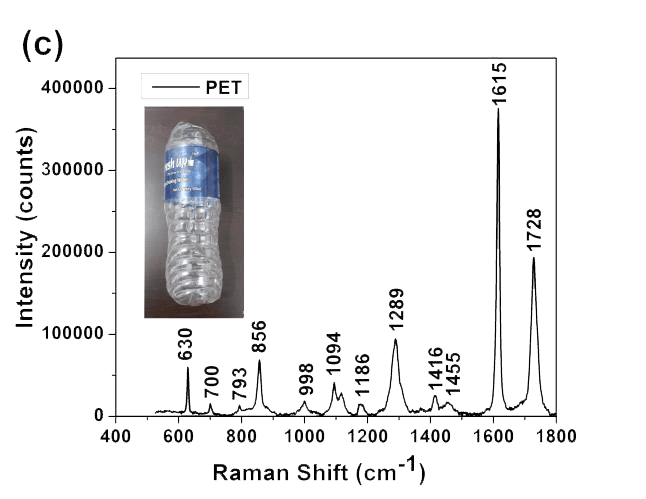 |
Microplastic Analysis Workflow for Water Samples
A typical Raman-based analysis follows five steps:
- Sample collection: Collect water from the source you are studying, such as a river, lake, wastewater outlet or drinking-water system.
- Filtration: Pass the sample through a suitable filter to capture suspended particles and concentrate the microplastics.
- Particle location: Examine the filter and pick out particles based on their physical appearance. Microscopy helps here, especially for small particles.
- Raman measurement: Focus the laser on a chosen particle and record the scattered light to generate its spectrum.
- Polymer identification: Match the spectrum against reference data or a spectral library to find the most likely polymer.
Pairing a microscope with a Raman system is why Raman microscopy works so well for small particles. It also makes it easier to tell plastics apart from other materials on the filter.
Why Use Raman for Microplastic Research?
Raman gives you chemical information without destroying the sample, so a particle can be measured and kept for further work. It also characterizes particles one at a time, instead of relying on bulk measurements that average everything together.
It can separate particles that look alike and identify polymers such as PE, PP, PS, PET and PVC. That matters when your research depends on knowing exactly which particles you have.
There are limits, though. Real environmental samples often contain dyes, pigments and organic matter, and these can affect the measurement. Fluorescence can also swamp the Raman signal. Careful sample preparation, the right laser, sensible measurement settings and experienced spectral interpretation all make a difference to the quality of your results.
Click for free Raman sampling »»
Microplastic Detection with IndiRAM
A Raman spectrometer for microplastic detection gives you a flexible way to check suspected plastic particles, in the field or in the lab.
The IndiRAM Confocal Raman Spectrometer by TechnoS Instruments fits into this kind of workflow. You collect and filter your water samples to concentrate the particles, then examine individual particles with the system and compare their spectra against reference data to identify the polymer.
A confocal Raman spectrometer is particularly useful when you need precise measurements from specific locations within a sample, especially when analysing small areas, layers, or microscopic features. Its confocal configuration helps improve spatial resolution and enables depth-resolved analysis. Performance for a specific application depends on factors such as sample composition, particle or feature size, fluorescence, material type, surface characteristics, and the measurement configuration.
As microplastic monitoring grows, methods that identify particles chemically, one by one, are becoming more important. Raman spectroscopy for microplastics offers exactly that, pairing molecular fingerprinting with particle-level analysis. With good sample preparation and careful spectral analysis, Raman spectrometer systems like IndiRAM can support microplastic studies by helping researchers characterize and identify suspected plastic particles in water. For environmental monitoring, research and material identification, Raman is a practical way to understand what is actually in your samples.
Explore the IndiRAM Raman Spectrometers by TechnoS Instruments for material identification and field Raman analysis.
Related Articles
- Field Testing Simplified: Benefits of Portable Raman Spectrometers
- How Raman Spectroscopy Detects Food Adulteration Before It Reaches Your Plate
- IndiRAM Raman Spectrometer for identification of Excipients in Pharmaceutical Drugs
- Innovations in Raman Spectroscopy: TechnoS at the Forefront
- Microplastic Contamination Detection in Food Grains: A Raman Spectroscopy Approach
- Raman Spectroscopy for Critical Minerals and Rare Earth Elements (REEs) – Mica Minerals
- Raman Spectroscopy for Illicit Drug Detection
- Raman Spectroscopy: A Transformative Tool Across Science, Industry, and Society
- Sustainable Innovations: Detecting Microplastics and Environmental Contaminants Using Raman Spectroscopy
- Diamond Genuineness Verification with IndiRAM DDS
- How Raman Spectroscopy is Advancing Battery Material Analysis
- Gemstone Identification with Raman Spectroscopy
- Quartz Identification Using Raman Spectroscopy
- Raman Spectrometer Principle and Core Components
- Raman Spectroscopy for Critical Minerals and Rare Earth Elements (REEs) - Cu